
Hiring the right people and managing their pay are two different business needs. Yet, the terms Recruitment and payroll outsourcing are sometimes used as if they mean the same thing. They do not.
Recruitment focuses on finding and providing workers for a business. Payroll outsourcing focuses on managing salary payments and related payroll tasks for employees or workers already engaged by the business.
The difference becomes important for startups, SMEs, and growing companies that want to manage costs, reduce administrative work, or expand their teams. Choosing the right service depends on whether the business needs help with people, payroll, or both.
This guide explains the difference between Recruitment and payroll outsourcing, what each service includes, and how businesses can decide which option suits their needs.
What Does Recruitment Mean?
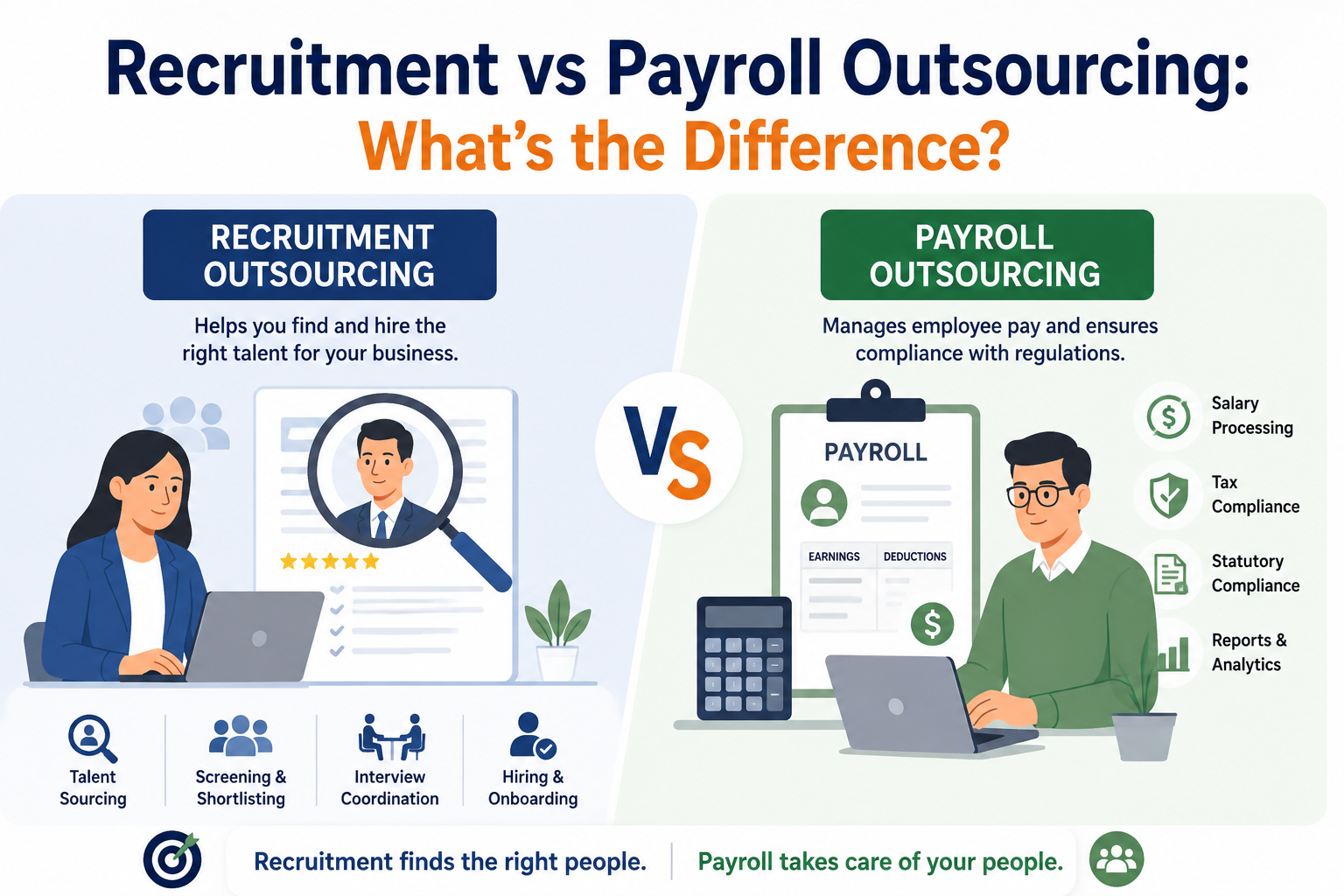
Recruitment is the process of helping a business find and place suitable workers for specific roles. A Recruitment provider may support recruitment, candidate screening, temporary staffing, contract hiring, or workforce management.
Businesses often use Recruitment when they need people but do not want to manage the entire hiring process internally.
Recruitment services may cover several stages of workforce planning and hiring.
These can include:
- Understanding role requirements
- Sourcing candidates
- Screening applications
- Shortlisting suitable candidates
- Helping businesses fill urgent vacancies
The exact service depends on the provider and the hiring model.
For example, an SME opening a new department may need several employees within a short period. A Recruitment provider can help source suitable candidates and reduce the amount of recruitment work handled internally.
What Is Payroll Outsourcing?
Payroll outsourcing involves assigning payroll-related tasks to an external service provider. The provider manages agreed payroll processes on behalf of the business.
Payroll outsourcing can be useful for companies that want external support with recurring salary and payroll administration.
Depending on the arrangement, payroll support may include:
- Salary calculations
- Payroll processing
- Employee payroll records
- Deductions
- Payslip preparation
- Payroll reports
- Payroll data management
- Support with applicable statutory requirements
Payroll outsourcing does not primarily focus on finding employees. Instead, it emphasizes handling payroll after workers have already joined the organization or workforce.
This distinction is important when businesses compare Recruitment with payroll support.
What Is Compliance Consulting?
Compliance consulting is a professional service that helps businesses understand and follow relevant laws, regulations, industry standards, and internal policies. A compliance consultant reviews business processes, identifies potential risks, and recommends practical steps to maintain regulatory compliance. Compliance Consulting can cover areas such as taxation, labour laws, financial reporting, data protection, and corporate requirements. For growing businesses, Compliance Consulting helps reduce the risk of penalties, legal issues, and operational disruptions while improving internal processes and accountability. By working with experienced compliance professionals, businesses can stay updated with changing regulations and focus more confidently on their core operations and growth.
Recruitment And Payroll Solve Different Problems
The simplest way to understand the difference is to look at the problem each service addresses.
Recruitment answers: “How can a company identify and handle the personnel it requires??”
Payroll outsourcing answers: : “How does a business manage employee compensation and payroll tasks?”
A company with vacant positions may need Recruitment support. A company with an existing workforce, but limited payroll capacity may need payroll support.
Some businesses may need both. For instance, a growing SME could use Recruitment support to recruit new employees and payroll outsourcing to manage their monthly payroll after those employees join.
Recruitment Services: What Do They Usually Cover?
Recruitment requirements can vary based on the size of the company and the type of roles it needs to fill.
Recruitment solutions may be used for permanent hiring, temporary workers, contract positions, or specific workforce requirements.
A Recruitment provider can help businesses handle tasks such as:
- Candidate Sourcing
The provider identifies potential candidates based on the role, skills, experience, and other agreed requirements.
- Screening And Shortlisting
Applications can be reviewed before suitable candidates are presented to the business. This can reduce the time spent reviewing large numbers of applications.
- Workforce Support
Some businesses need workers for a fixed period or during periods of increased demand. Recruitment support can help address these short-term requirements.
- Hiring For Specialist Roles
Certain roles may require specific skills or experience. External Recruitment support can help businesses reach candidates with relevant backgrounds.
The business remains responsible for defining what it needs from the role and assessing whether candidates meet its requirements.
Payroll Services: What Do They Include?
Payroll services focus on the financial and administrative side of paying workers.
Payroll needs to be accurate because mistakes can affect employees and create additional administrative work for the business.
Typical payroll activities may include:
- Collecting payroll information
- Calculating employee pays
- Processing deductions
- Preparing pay slips
- Maintaining payroll records
- Preparing payroll reports
- Managing recurring payroll schedules
The scope can be adjusted based on the company’s requirements.
A small business with a limited workforce may need basic payroll processing. A larger organization may require wider support across multiple employee groups or locations.
Recruitment Vs Payroll Outsourcing: Key Differences
While both services involve people and business operations, their primary functions are different.
| Area | Staffing | Payroll Outsourcing |
| Main purpose | Finding and providing workers | Managing payroll |
| Primary focus | Recruitment and workforce needs | Salary and payroll administration |
| Candidate sourcing | Usually included | Not the main purpose |
| Salary processing | May depend on the Recruitment model | Core service |
| Workforce planning | Often supported | Limited |
| Payroll records | May be part of the service | Usually included |
| Best suited for | Businesses needing workers | Businesses needing payroll support |
The decision should be based on the business problem, not the service’s name.
Recruitment Vs Payroll Outsourcing
The difference becomes clearer when looking at recruitment vs payroll outsourcing. Recruitment focuses on bringing new people into a business. It includes activities such as advertising roles, sourcing candidates, screening applications, and supporting the hiring process.
Payroll outsourcing begins after the business has people who need to be paid. It is dedicated to handling salary processing and managing payroll data.
A company hiring ten new employees may require recruitment support. After employees are added to the payroll, the company might also require payroll services.
Therefore, recruitment and payroll outsourcing are not competing services. They address different stages of the employee lifecycle.
When Should a Business Choose Staffing?
Recruitment can be suitable when a business has an immediate or ongoing workforce requirement.
A company may consider Recruitment support when:
- Several positions need to be filled
- Internal recruitment resources are limited
- Temporary workers are required
- Specialist skills are difficult to source
- Seasonal demand increases
- The business is entering a new location
- The hiring team needs additional support
Recruitment services can help businesses manage recruitment activity without placing every task on an internal HR team.
However, businesses should still define role requirements clearly and assess candidates carefully before making hiring decisions.
When Is Payroll Outsourcing a Better Choice?
Payroll outsourcing may be more suitable when the business already has an established workforce but wants external support with payroll administration.
It can be considered when:
- Payroll takes too much internal time
- Payroll processes are becoming more complex
- The business is expanding its workforce
- Internal payroll resources are limited
- Regular payroll reporting is required
- The business wants a defined external payroll process
Payroll outsourcing can provide ongoing support without requiring the company to build a larger internal payroll function.
The business should still review payroll information and maintain appropriate oversight.
Can A Business Use Both Services?
Yes. Recruitment and payroll outsourcing can work together.
Consider a growing company that needs to hire 20 employees for a new project. It may use Recruitment solutions to identify and recruit suitable workers. After the employees join, the business may use payroll services to manage their monthly pay.
This creates support across two different stages:
- Recruitment → Find and manage workforce requirements
- Payroll → Process and manage employee pay
Using both services can be useful for businesses that are growing quickly and want external support across recruitment and payroll administration.
What Should Businesses Check Before Choosing a Provider?
Selecting an outsourcing provider requires careful assessment. Businesses should look beyond the number of services listed on a website.
Key areas to review include:
- Service scope: Confirm exactly which tasks are included.
- Experience: Check whether the provider has experience supporting similar businesses.
- Technology: Understand the systems used for recruitment or payroll.
- Data protection: Payroll and employee records contain sensitive information.
- Communication: Establish how queries and updates will be managed.
- Scalability: Check whether the service can support future growth.
- Reporting: Confirm what reports the business will receive and how often.
- Responsibilities: Make sure internal and external responsibilities are clearly defined.
A clear agreement can prevent confusion and help both sides understand their roles.
Choosing The Right Support for Business Growth
Recruitment and payroll outsourcing are different services, but both can support growing businesses. Recruitment focuses on finding people and meeting workforce needs. Payroll outsourcing focuses on paying employees and managing related payroll administration.
Businesses should first identify the problem they need to solve. If the challenge is finding suitable workers, Recruitment may be the better fit. If the workforce is already in place but payroll has become difficult to manage, payroll outsourcing may provide the required support.
For businesses facing both challenges, combining Recruitment solutions with payroll support can provide broader assistance.
Infinzi supports startups, SMEs, and growing businesses with professional business services. They provide Recruitment and payroll-related support designed around different operational requirements. Their approach allows businesses to seek external assistance for important workforce and payroll functions while keeping their internal teams focused on core activities. Businesses looking for Recruitment services or payroll outsourcing can connect with Infinzi to discuss their specific requirements and identify suitable support.