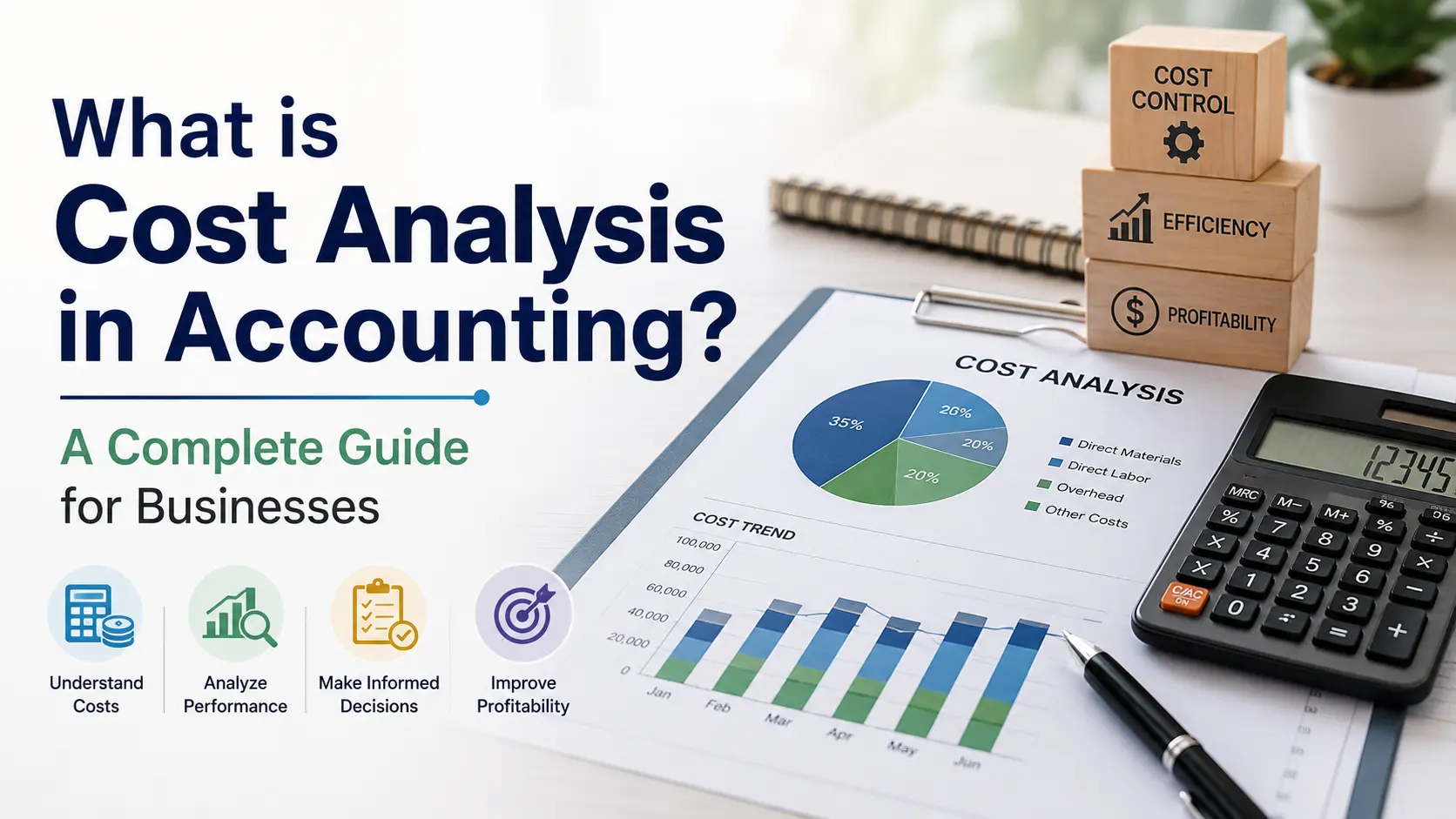

Many businesses lose control over profits simply because they don’t understand where their costs are going, making cost clarity essential for better financial decisions.
Businesses today operate in a highly competitive environment where every expense directly impacts profitability. Without clear financial visibility, it becomes difficult to control costs and plan sustainable growth.
The cost analysis definition helps organizations understand how expenses are structured and where money is being spent. It provides a clear approach to evaluating business costs and supports better financial decision-making.
With proper cost evaluation, companies can improve budgeting, reduce unnecessary expenses, and strengthen overall financial control. This makes it an essential part of modern accounting and business management practices.
Understanding Cost Analysis in Accounting
Cost analysis is the process of studying all business expenses to understand how money is spent across operations. It helps companies make informed financial and strategic decisions.
The cost analysis meaning focuses on identifying, classifying, and evaluating costs for better control and planning. It is widely used by businesses for pricing, budgeting, and performance evaluation.
Key Components
- Direct costs (raw material, labor)
- Indirect costs (rent, utilities, admin)
- Fixed costs (unchanged expenses)
- Variable costs (fluctuating expenses)
Simple Breakdown Table
| Component Type | Example | Purpose |
| Direct Cost | Raw material | Production cost tracking |
| Indirect Cost | Electricity | Operational expense control |
| Fixed Cost | Rent | Stability planning |
| Variable Cost | Sales commission | Profit analysis |
The cost analysis definition helps businesses understand how costs are structured and behave across operations. It also supports decision-makers in building accurate budgets and improving financial planning.
What is Cost Ascertainment in Accounting?
Cost ascertainment is the process of determining the actual cost of goods or services after production is completed. It helps ensure financial records are accurate and reflect the true value of business operations.
The cost ascertainment meaning is understood as the method used to identify real expenses based on verified accounting data. It supports accurate costing and plays a key role in inventory valuation and financial reporting.
Process Steps
- Collect all expense records
- Identify production-related costs
- Add direct and indirect expenses
- Finalize total cost per unit
Simple Flow
Expense Tracking → Classification → Calculation → Final Cost Output
The process ensures transparency in cost reporting by clearly identifying actual expenses. It also supports the preparation of accurate financial statements and helps maintain audit compliance.
Importance of Cost Analysis in Business
Cost analysis plays a major role in improving financial discipline and business efficiency. It helps organizations understand spending patterns clearly.
The importance of cost analysis lies in its ability to support better decisions and reduce unnecessary expenses. It is a core part of financial planning in modern businesses.
Key Benefits
- Improves cost control
- Supports better pricing decisions
- Enhances profit margins
- Reduces financial risks
Business Impact Table
| Area | Benefit |
| Pricing | Accurate product pricing |
| Budgeting | Better financial planning |
| Profitability | Higher margins |
| Strategy | Smarter decision-making |
The importance of cost analysis becomes clear when businesses focus on sustainable growth and long-term stability. It also plays a key role in improving operational efficiency across different departments.
Cost Analysis Methods Used in Accounting
Different methods are used depending on the size and complexity of a business, and each one offers a unique financial insight. Understanding the cost analysis meaning helps organizations choose the most suitable approach for evaluating costs and making informed financial decisions.
Common Methods
- Activity-Based Costing
- Standard Costing
- Break-even Analysis
- Marginal Costing
Comparison Table
| Method | Use Case | Outcome |
| ABC Costing | Complex operations | Activity-level cost view |
| Standard Costing | Manufacturing | Cost variance control |
| Break-even | Pricing decisions | Profit threshold |
| Marginal Costing | Expansion planning | Cost behavior insight |
These methods become more practical when applied in real business scenarios, helping professionals interpret financial data with greater clarity. It also improves decision-making by giving a structured view of overall costs.
Role of Accounting Firms in Mumbai
Professional financial experts help businesses manage cost structures efficiently. Many companies rely on external expertise for better accuracy and control.
Accounting firms in Mumbai provide structured financial support, including cost tracking and reporting. They help businesses improve efficiency and financial transparency.
Services Offered
- Bookkeeping and accounting
- Cost reporting
- Budget preparation
- Financial analysis
Why Businesses Prefer Them
- Expert financial handling
- Reduced operational burden
- Better compliance
- Improved decision-making
Many startups and SMEs rely on professional support to manage their financial operations more effectively. Such firms also help improve cost efficiency and support long-term business scalability.
Cost Analysis in Business Decision Making
Cost analysis supports strategic decisions across all business functions and ensures they are backed by financial clarity. It helps management evaluate financial performance more effectively and make decisions based on data rather than assumptions.
Decision Areas
- Product pricing
- Expansion planning
- Cost reduction strategies
- Investment evaluation
Simple Decision Flow
Data Collection → Cost Analysis → Insights → Business Decision
The cost analysis definition strengthens financial planning by improving accuracy in how costs are identified and evaluated. It also helps align overall spending patterns with business strategy for better financial control.
How Businesses Apply Cost Analysis
Businesses use cost analysis to identify waste, improve efficiency, and increase profits. It is used across industries for financial optimization.
The importance of cost analysis is reflected in how it helps businesses control expenses more effectively and avoid unnecessary costs. It brings structure to financial evaluation, making overall cost management clearer and more practical.
Application Areas
- Manufacturing cost control
- Service pricing models
- Supply chain optimization
- Budget forecasting
In highly competitive markets, financial clarity often becomes the deciding factor between steady growth and business instability. Companies need strong control over their expenses to stay efficient and adaptable.
It also plays a key role in supporting long-term financial sustainability through better planning and resource management.
Building Stronger Financial Systems Through Cost Understanding
Cost analysis plays a key role in accounting by helping businesses clearly understand their expenses and manage them in a more structured way. The cost analysis definition and meaning together improve financial clarity and support better decision-making across different levels of the organisation.
Infinzi helps businesses streamline accounting processes and improve overall financial efficiency through organised outsourcing solutions. They support companies in handling reporting, compliance, and operational finance with greater accuracy and control.
For businesses aiming to scale efficiently, understanding processes like the cost ascertainment meaning becomes important for maintaining accuracy in financial outcomes. Connect with their team to strengthen your financial operations and improve cost control with a more structured approach today.